The main dates in the story of kauri and the people of Aotearoa, drawn from the sources below.
- Up to 60,000 years agoKauri fall into northern swamps and are preserved as swamp kauri.
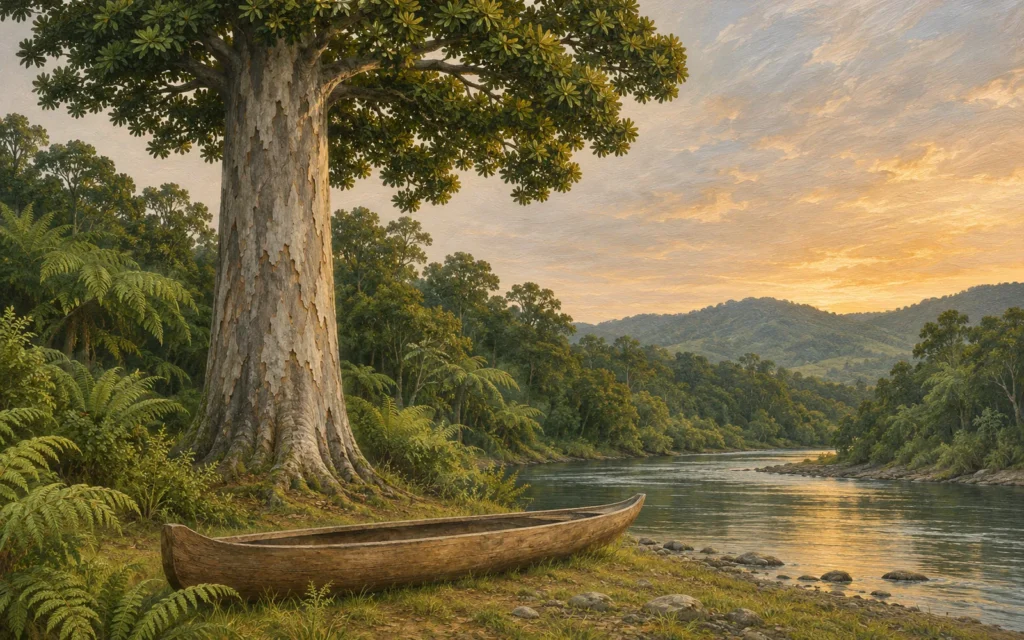
- Before 1769Māori value kauri as rangatira of the northern forest, use kāpia (gum) and build waka from kauri.
- 1769James Cook finds kauri gum at Mercury Bay.
- Mid-1840sKauri gum is exported to London and America for varnish.
- 1850sTimber driving dams appear in kauri forests; around 3,000 are eventually built.
- 1850 to 1900Kauri gum is Auckland's main export, ahead of gold, wool and timber.
- About 1885Dalmatian diggers arrive on the gumfields.
- 1890sAbout 20,000 people dig gum, 7,000 of them full time; gum is bled from living trees.
- 1898The Kauri Gum Industry Act sets aside government gum reserves.
- 1903About 340,000 cubic metres of kauri is milled in one year, around 40% exported.
- 1905Bleeding gum from living trees is banned in state forests.
- About 1910Low-grade gum is used to make linoleum.
- 1924Tāne Mahuta is found during the survey for State Highway 12; Dancing Camp Dam is built in the Kauaeranga Valley.
- 1920s to 1930sA final push leaves only patches of kauri forest standing; synthetic resins undercut gum.
- 1937Te Matua Ngahere is first recorded.
- 1940sGum digging becomes a “sunset industry”.
- 1970Kauaeranga's remaining forest is protected in Coromandel Forest Park.
- 2018The Supreme Court rules on what counts as a finished swamp kauri product for export.
- 2022The National Pest Management Plan for kauri dieback comes into force.