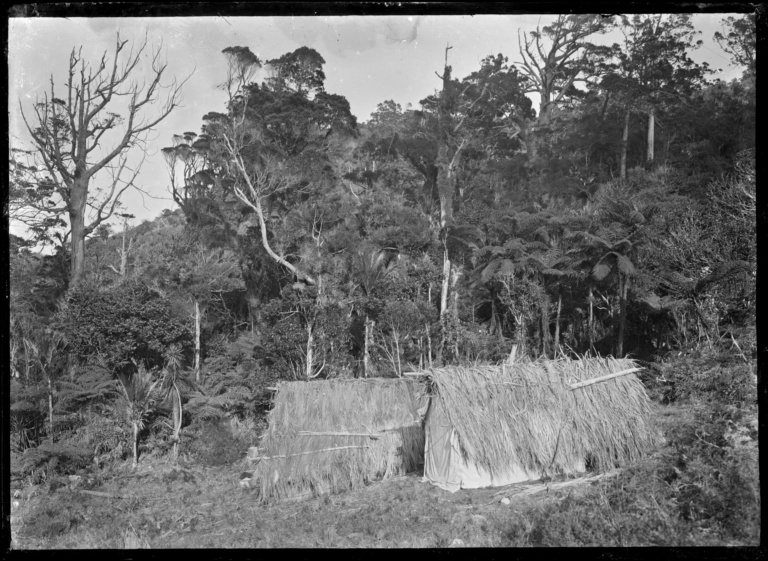
The Kauri Gum Industry Act 1898 created a new category of Crown land: kauri gum reserves. These areas covered around 100,000 hectares and were exclusively for the use of British subjects, including Māori. The reserves were areas of government-owned land that were not to be available for settlement, but only for kauri-gum digging. The Act also introduced a licensing system for anyone who wanted to dig on these government reserves.
Why the Act was passed
The law was passed after a commission of enquiry, set up because of British diggers’ complaints that Dalmatians were sending their earnings back home. In 1898 a second commission described Dalmatians as hardy, sober, industrious, law-abiding people who would make admirable settlers, but nothing was done to encourage settlement. Instead, the government passed the Kauri Gum Industry Act.
The regulations were partly aimed at restricting Dalmatian diggers. As a result, Dalmatians shifted their focus, and many made arrangements with private landowners, paying a rental for the right to dig gum. Private lands could still be worked by anyone who had an arrangement with the landowner.
Setting aside the reserves
An area of 7,750 acres in the Tutamoe Survey District, Hokianga County, was gazetted under the Act. Immediately after the Act came into force, areas in every county where kauri gum was known to exist were laid out on office records, and plans and descriptions prepared for proclamation. By 1901, 240,088 acres had been proclaimed as reserves within which only settlers were allowed to dig for gum.
From the passing of the Act up to 1914 a total area of 276,210 acres had been set apart as kauri-gum reserves, and an area of 48,849 acres withdrawn from the operations of the Act. The total area of the gum-bearing lands was estimated in 1898 at 814,000 acres. Of the Crown lands, 276,000 acres were set aside in 1898 as kauri-gum reserves. Since then about 120,000 acres had been withdrawn from the reserves for settlement and other purposes, the greater proportion of the land having been found to be not gum-bearing.
Who could dig on the reserves
The reserves were exclusively for the use of British subjects, including Māori, and a licensing system was introduced. The Act established kauri gum reserves exclusively for British subjects, and a licensing system with a three-month qualification for new arrivals. The 1898 Kauri Gum Industry Act and its 1908 amendment required gum diggers working on government land to be licensed.
Laws passed in 1908 and 1910 further restricted Dalmatians’ rights by confining digging licences to British subjects. The licensing fees were relatively modest. A 1947 licence cost £2 and allowed Tony Yelash of Ahipara to dig for gum on government-owned gum reserves for one year.
Types of gum land
The gum lands were of two main classes, the clay lands and the peat swamps. The swamps were particularly rich. The Mangawai or Coal Hill Kauri-gum Reserve comprised an area of 3,669 acres, of which about 800 acres was rich gum-bearing swamp land. Some reserves held exceptional value in buried gum.
You can learn more about the grades and quality of gum that diggers found in our guide to kauri gum grades. See images and stories of the diggers’ lives in our gum diggers gallery.
Later developments
A Royal Commission recommended that the reservation be cancelled over 71,164 acres of kauri-gum reserves, that the State should break in and develop the gum lands before disposal, that the checking of sand-drift on certain areas and the afforestation of other areas should be dealt with, and that a Department be set up to take charge of the gum. The Kauri-gum Industry Act was amended, and gave the Minister of Lands general powers to work kauri-gum lands belonging to the Crown, and to purchase kauri-gum from diggers and sell it to the best advantage.
The reserves gradually shrank as land was withdrawn for other purposes. Some gumland was left so potholed and in such a bad state that it was practically of little use to any one. The impact of gum digging can still be seen across parts of Northland, where the industry was concentrated.
The gum industry’s scale
The gumfield reserves were created at the peak of the industry. In the 1890s some 20,000 people were involved in the gum industry, 7,000 of them working full time. From 1850 to 1950, gum exports totalled 450,000 tons, and from 1850 to 1900 gum was Auckland’s main export, ahead of gold, wool and kauri timber.
Today, kauri gum is valued by collectors and artists. You can find contemporary work in kauri gum art and jewellery, and learn more about the history at museums and heritage sites around the North Island.