“What is the biggest kauri tree?” sounds like a simple question, but the answer depends on what you measure. Tāne Mahuta is the largest living kauri by trunk volume and height. Te Matua Ngahere is the stoutest, with the widest girth. Both stand in Waipoua Forest in Northland, and both are worth understanding before you visit.
Biggest by what measure?
Tree size can be described three ways, and each gives a different champion.
- Height: how tall the tree is from base to crown. Kauri are not the tallest trees in the country, but they hold their girth to a great height.
- Girth: the distance around the trunk, usually measured at breast height (about 1.4 m). It tells you how stout a tree is.
- Trunk volume: an estimate of the timber in the trunk, up to the first major branches. It is usually considered the fairest measure of overall size for kauri, because kauri trunks are long, clear and cylindrical.
Figures quoted for the big trees come mainly from the Department of Conservation (DOC) and from historic surveys. Trees grow, lose limbs and are measured in different ways, so you will see small differences between sources. Treat the numbers below as approximate.
Tāne Mahuta, “Lord of the Forest”
Tāne Mahuta is the best known kauri in the country. It is named for Tāne, the atua (god) of forests and birds in Māori tradition, who in the story pushed apart his parents Ranginui and Papatūānuku to bring light into the world.
DOC’s commonly cited figures give Tāne Mahuta a height of around 51 m, a girth of around 13.8 m and a clear trunk of about 17.7 m before the first branches. Its trunk volume is given as roughly 245 cubic metres, which makes it the largest known living kauri by volume. Its age is usually given as somewhere between 1,250 and 2,500 years. That is a wide range, and the reason is explained below.
Tāne Mahuta is easy to reach. It stands beside State Highway 12 in Waipoua Forest, and a short, formed track leads from the car park to a viewing platform. That makes it one of the most accessible giant trees in the country, including for people who cannot manage a long tramp.
Te Matua Ngahere, “Father of the Forest”
Te Matua Ngahere is shorter than Tāne Mahuta, at roughly 30 m, but far wider. Its girth is usually given as about 16.4 m, which makes it the stoutest known living kauri. It has a squat, massive trunk and a broad, heavily branched crown, so it looks very different from the tall, straight Tāne Mahuta.
It is believed to be more than 2,000 years old, and is often described as one of the oldest living kauri. Reaching it takes a walk through the forest from the road, which DOC describes as a bush walk of about 20 minutes each way. Because of that walk, you see more of the surrounding forest, with kauri of many ages growing around you.
Near Te Matua Ngahere you can also find the Four Sisters, a cluster of kauri growing close together that look almost like a single group trunk. If you are making the effort to go to the Father of the Forest, they are a natural pairing.
Why do the age estimates vary so much?
You will often read “1,250 to 2,500 years” or “over 2,000 years” for a single tree. The reason is that the age of a living giant is hard to measure directly.
- Counting growth rings needs a core sample, and a core from a huge trunk may not reach the centre. Coring also risks harming a protected tree.
- Many old kauri have hollow or decayed hearts, so the oldest wood is missing.
- Kauri growth rates vary with site, light and competition, so estimating from size alone is rough.
Scientists have dated ancient swamp kauri, which are buried logs, with much better precision, because the full cross-section is available. Living giants are a different matter, so the honest answer is “very old, probably well over a thousand years”.
What about the giants that were lost?
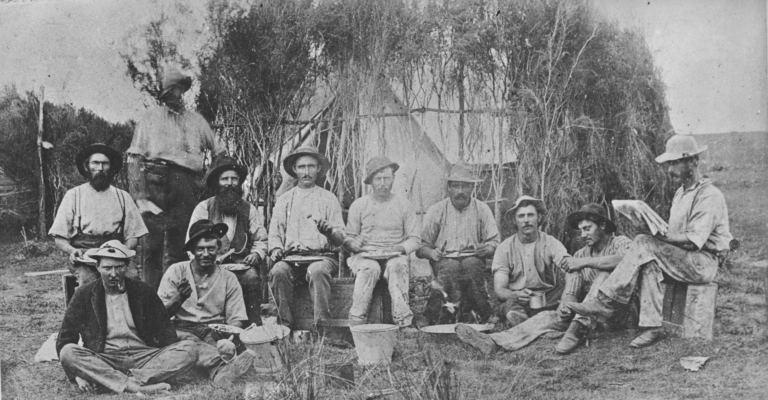
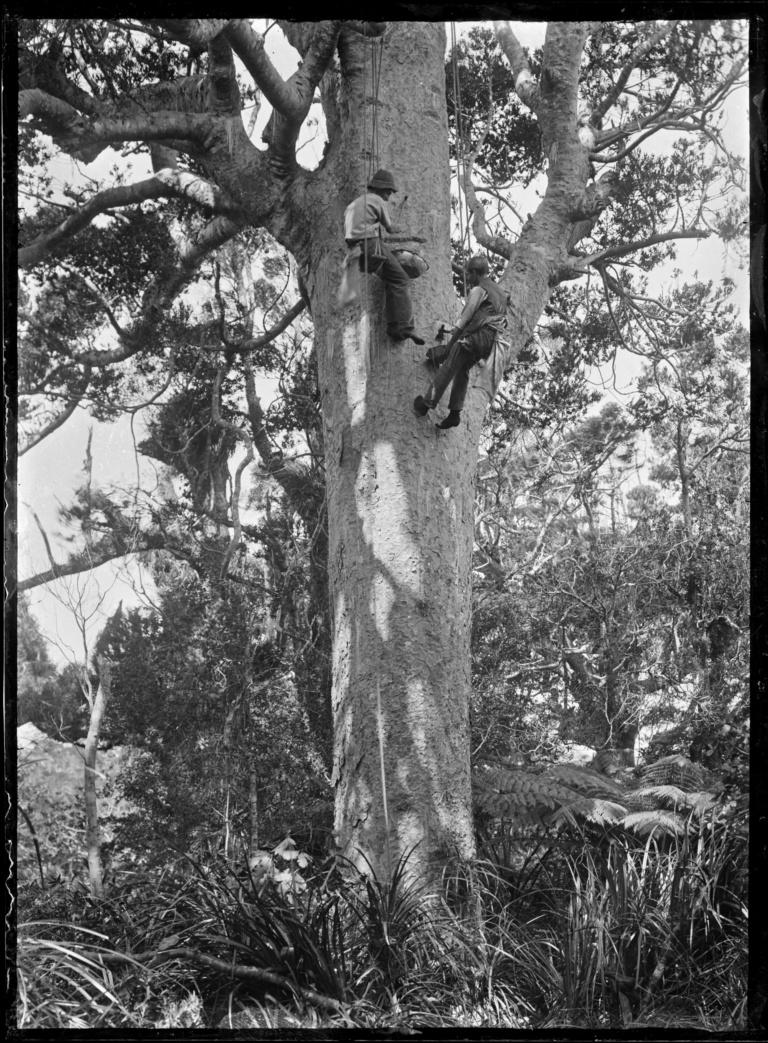
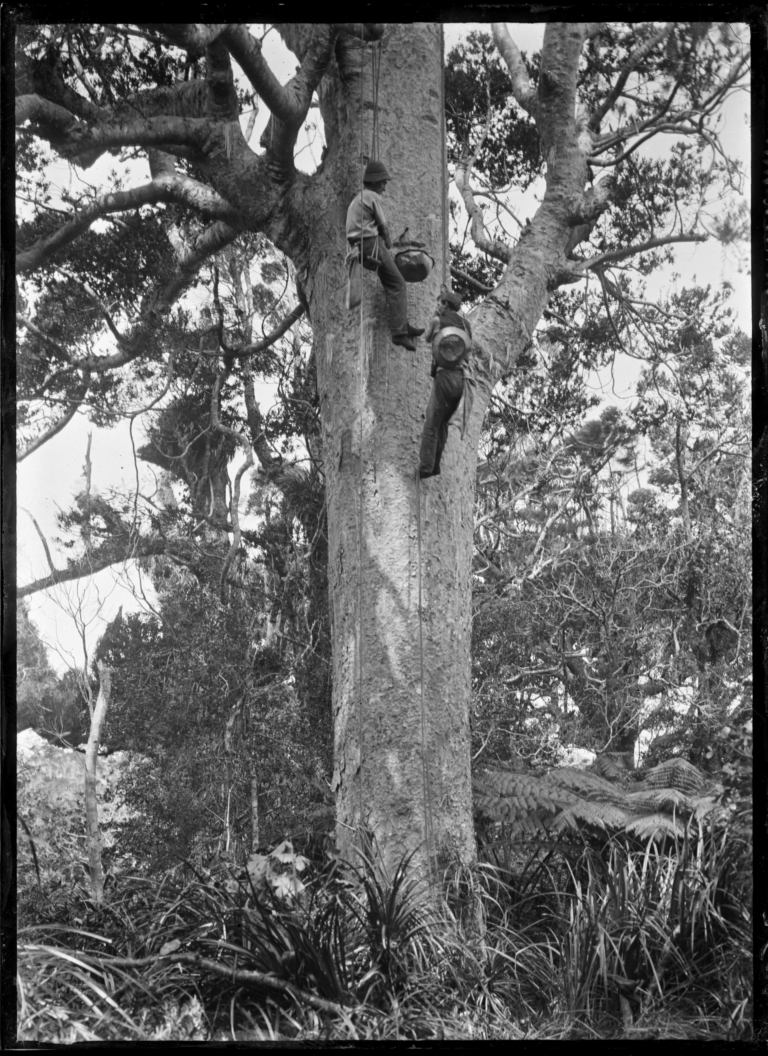
The trees we can visit today are survivors. Kauri forest once covered a large part of the upper North Island, and the timber and gum industries of the 19th and early 20th centuries cleared most of it. Early accounts describe individual trees larger than anything standing today, though these records were made by timber workers and surveyors using varying methods, so the figures need care. What is clear is that very few large old trees were left, which is part of why the remaining giants are valued so highly.
If you want to see what a big kauri trunk looks like once it has been felled, and to learn about the milling and gum history, the Kauri Museum at Matakohe in Northland is the best place to start. It holds large timber sections, tools and displays about the people who worked the forests.
Other big kauri worth knowing about
Waipoua is famous, but large kauri grow elsewhere in the upper North Island, including in the Waitākere Ranges, on the Coromandel Peninsula, and on Aotea Great Barrier Island. None of these trees match the two Waipoua giants, but there are impressive specimens, and the walks often have far fewer visitors. Check DOC or your local council’s track page for current details before you go, because some tracks have changed or closed in recent years.
Visiting a giant kauri without harming it
Every large kauri is vulnerable to kauri dieback disease, which is caused by the soil-borne organism Phytophthora agathidicida. It spreads through soil, including the tiny amounts on shoes, tyres and paws, and it attacks the roots. Once a tree is infected there is currently no cure.
That is why tracks near the giants have boardwalks, fences and cleaning stations. Follow these basic rules:
- Check track status first. DOC and councils update closures and rāhui. Respect them.
- Clean your footwear before and after every forest visit. Remove all visible soil, then use the cleaning station: brush off, then spray.
- Stay on the track. Do not step off the path to get a better photo.
- Never touch or climb on the roots or stand inside the fenced area around a tree.
- Keep dogs out unless a track is explicitly open to them, and keep them on a lead if allowed.
- Clean gear and vehicles if you travel between forests in one trip.
Waipoua Forest is also a place of deep significance to Te Roroa, the iwi with ties to the area. Treat the forest and the trees with respect, speak quietly, and follow any local guidance posted on site.
Tips for photographing giant kauri
- Bring a wide-angle lens, because the trunks are much bigger than they look from the platform.
- Overcast light suits the forest. Harsh sun makes strong contrast under the canopy.
- For scale, include a person at a respectful distance on the boardwalk.
- Shoot upward from the viewing area to show the clear trunk and how high the first branches are.
Quick comparison
- Tāne Mahuta: tallest and largest by volume of the famous pair, about 51 m high, with a short accessible walk.
- Te Matua Ngahere: stoutest, with a girth of about 16.4 m, and a longer bush walk.
Whichever you visit, you are looking at a tree that was growing long before humans reached Aotearoa, and your care on the track is part of what keeps it standing.